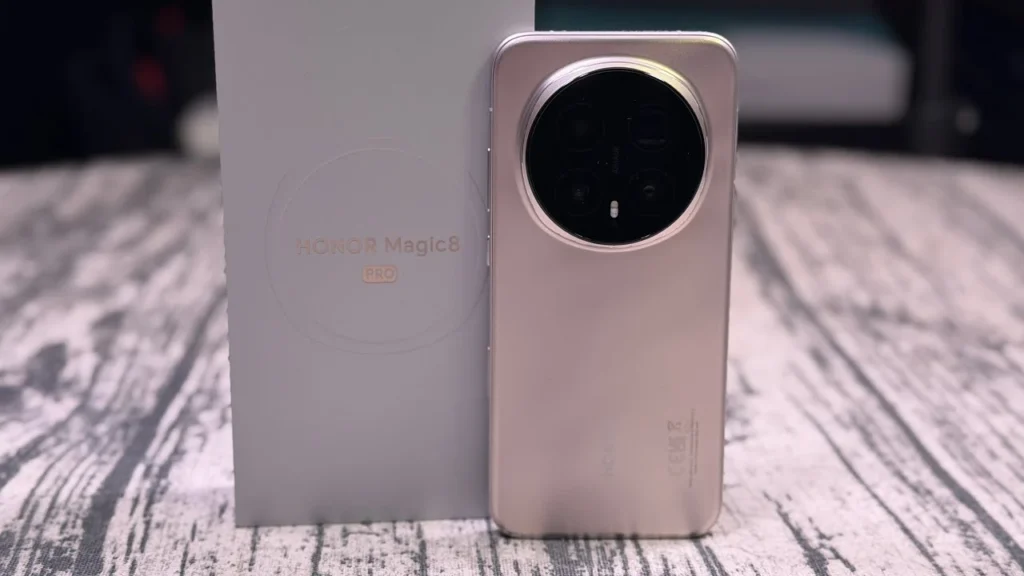
Honor didn’t try to copy the usual flagship formula with the Magic 8 Pro — it sharpened the focus. With a bright LTPO display, huge 7,100 mAh battery, a flagship Snapdragon 8 Elite Gen 5 engine and an AI-first camera stack, this phone is built around everyday reliability rather than headline specs alone. The question the Magic 8 Pro asks is simple: do you want a polished, stamina-first flagship that behaves like a daily workhorse? If so, this is worth a hard look — but there are trade-offs worth knowing.
Exterior design: slimmer, hand-friendly, with a clear identity
Honor trimmed the screen to 6.71 inches (smaller than its predecessor) and that choice pays off in real-world handling. The phone feels thinner and easier to hold; one-handed use stops feeling like contortion practice. The back’s gentle curve and the flat front with a subtle 2.5D edge strike a sensible balance between comfort and premium looks.
The circular rear camera module — framed like a soft “Jade Cong” — dominates the design and gives the phone character. That large camera stack nudges the Magic 8 Pro to 213 grams and makes the upper body feel fractionally heavier; it’s noticeable but not uncomfortable for day-long use. Honor also adds a physical AI button on the frame — useful and increasingly relevant as on-device AI shortcuts become a practical differentiator. Build quality is solid: NanoCrystal Shield frosted glass, an aluminum frame, IP68/IP69/IP69K ratings and an SGS 5-star durability claim (survives drops up to 1.5 meters) mean this is a phone meant to be used, not pampered.
Display: absurdly bright when you need it, gentle when you don’t
The 6.71-inch LTPO panel (1256 × 2808, ~459 ppi) is both sharp and practical. Honor’s 1–120 Hz adaptive refresh keeps animations smooth and battery waste low. The headline brightness figure may read 6,000 nits, but in realistic tests the screen hits nearly 4,000 nits at 20% APL and about 1,725 nits in full-screen mode — more than enough to stay readable in harsh sunlight. At the other end, a 1-nit minimum makes night use comfortable.
Honor didn’t stop at raw output: 4320 Hz PWM dimming, circadian-aware brightness adjustments and eye-comfort modes show this panel was designed for long sessions, not just a one-off brightness test. Biometric options (3D face with TOF and an in-display ultrasonic fingerprint sensor) complete the premium, everyday picture.
Camera system: competent, nuanced, and focused on usable zoom
The triple-camera array is pragmatic rather than showy. The 50MP main (uses large sensor and 12MP output via binning) nails natural color and wide dynamic range; processing leans towards realism instead of over-saturation. The 50MP ultra-wide covers a wide 122° field and doubles as a close-up option — good enough in daylight, less impressive in low light.
The standout is the 200MP periscope telephoto with 3.7x optical zoom (roughly 85mm equivalent). It’s the feature that gives this phone a clear photographic identity: usable optical reach with preserved detail and AI assistance that keeps zoomed shots respectable at longer distances. Video tops out at 4K with effective stabilization for everyday creators. This is where it divides opinion: if you want extreme low-light ultrawide drama, look elsewhere; if you value reliable mid-tele performance for portraits and distant subjects, the Magic 8 Pro delivers.

Performance: flagship speed with sensible thermal behavior
Powered by the Snapdragon 8 Elite Gen 5 and paired with 12GB–16GB RAM options, the Magic 8 Pro behaves like a flagship should — fluid UI, fast app switching, and comfortable multitasking. Sustained workloads such as gaming, video capture and editing run smoothly and the phone resists rapid overheating better than many rivals. GPU performance easily handles demanding titles at high settings, with only the expected slight throttling under very long, intense sessions. Storage goes up to 512GB or 1TB in some markets, so space won’t be the weak link.
Battery and charging: endurance is the headline
This is the Magic 8 Pro’s clearest advantage. A 7,100 mAh silicon-carbon battery is a bold choice for a flagship and yields exceptional real-world endurance — a full day with heavy use and comfortable two-day life with moderate use. Charging keeps pace with modern expectations: 100W wired and 80W wireless support reduce downtime dramatically, with a full wired charge taking under 50 minutes on compatible chargers. For users who hate hunting for a charger mid-day, this is a decisive benefit.
Who should buy the Honor Magic 8 Pro?
Buy it if you want a flagship that prioritizes daily usability: a blazingly bright, battery-dominant screen, consistent performance, a genuine telephoto camera and practical durability. This phone is for people who treat their phone like a work tool and expect it to last through heavy days without fuss.
Skip it if you prize the lightest possible device or crave headline-grabbing ultrawide/low-light camera theatrics. The weight and camera trade-offs won’t please everyone, and the styling choices aren’t for buyers chasing novelty.
Final verdict: a distinctive, sensible flagship
Honor didn’t try to be everything to everyone with the Magic 8 Pro — it chose strength in endurance, optical zoom and a sensible feature set. The price is high, but the hardware choices back the claim: this is a premium phone designed for real life rather than show-floor specs. If you value battery life, visible-bright displays, and a useful telephoto camera in a durable, thoughtfully designed package, the Magic 8 Pro is a compelling, well-balanced flagship.

Tanu is a technology content writer at gemch.in who tracks smartphone launches, features, and pricing trends. She writes user-focused articles that explain what matters most in everyday smartphone use.