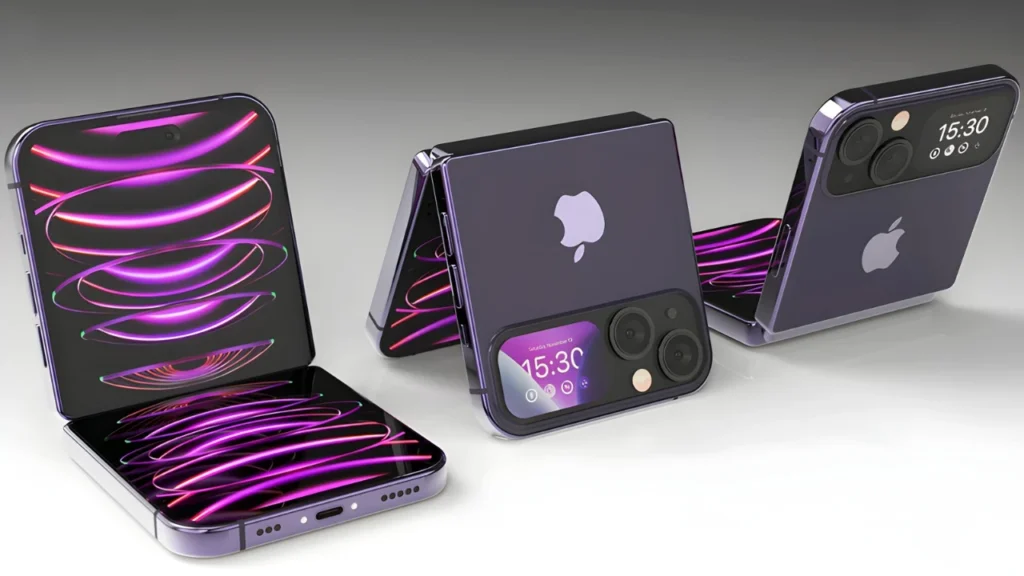
Rumours about an iPhone that flips shut like a clamshell have been gathering steam — and for once the logic is obvious. Analyst Mark Gurman first flagged Apple’s interest in a clamshell foldable, a development later backed by market research firm Stone Partners. If Apple ships an iPhone Flip, it won’t be a gimmick — it will be a strategic, lower-friction way to bring folding hardware to millions.
Why a clamshell makes far more sense than a book-style fold
A book-style foldable demands a complete rethink: new internal layouts, a different aspect ratio, and deep iOS changes to make a large, tablet-like screen feel native. Samsung spent several generations refining that recipe for the Galaxy Fold. There’s no guarantee Apple would nail it first try.
A clamshell, by contrast, keeps the familiar iPhone experience largely intact. The main screen’s size and aspect ratio remain unchanged, so iOS needs only targeted tweaks for the external cover display. Internally, camera placement, chipset choice and most components can stay where they are — only the battery becomes a split-cell task rather than a ground-up redesign. That’s not trivial, but it’s a manageable engineering trade-off compared with reinventing the phone.

Price will determine whether this idea lives or dies
This is where the business case either holds or collapses. Rumours peg a “book-shaped” iPhone Fold as a super-premium device with a price that could reach $2,399 — well above many current foldables and above the Galaxy Z Fold 7’s $1,999 launch. Apple’s track record with ultra-premium hardware is instructive: the Vision Pro launched at $3,500 and adoption has been cautious.
Clamshell foldables show a different market dynamic. They’re lighter, cheaper to make, and — crucially — easier to sell. The Galaxy Z Flip costs roughly half a Fold, and Motorola has positioned Razr models at roughly $699, competitive with many non-folding phones. If Apple can bring a Flip under $1,000, the device becomes not just a curiosity but a mainstream alternative. If priced at $2,399, it won’t.
Real-world use: why many users prefer flip phones
Book-style foldables ask users to change how they handle a phone: two-handed use, careful balancing to avoid drops, and carrying extra weight. For many people that’s a step backward. Even Android users, who’ve had years to adapt, often treat big folds as niche devices.
Clamshells preserve single-handed convenience when open and become notably pocket-friendlier when folded. Folding and unfolding is quick, intuitive, and — yes — just a little fun. That portability and familiarity could be the difference between a novelty and real sales.

The trade-offs buyers must accept
A clamshell won’t deliver the same tablet-like workspace as a book-style fold, and that’s the point of the trade-off: you get portability and familiarity in exchange for less on-device multitasking space. For most buyers, that trade-off will make sense. For a larger, productivity-first audience, a full Fold remains the better choice — if Apple makes one.
Final verdict: start with the Flip, then expand
If Apple wants folding to matter at scale, the Flip is the logical first move. It’s easier to engineer, simpler to integrate with iOS, and has a far more defensible price-performance story. That doesn’t rule out an eventual iPhone Fold, but launching a clamshell first keeps risk low and reach high.
For now, iPhone Flip talk remains in the rumour stage — but it’s exactly the kind of product that could turn folding from a luxury experiment into a mainstream option. Fans hope Apple ships both a Fold and a Flip; from a practical, market-driven perspective, the Flip is the smarter opening gambit.

Tanu is a technology content writer at gemch.in who tracks smartphone launches, features, and pricing trends. She writes user-focused articles that explain what matters most in everyday smartphone use.