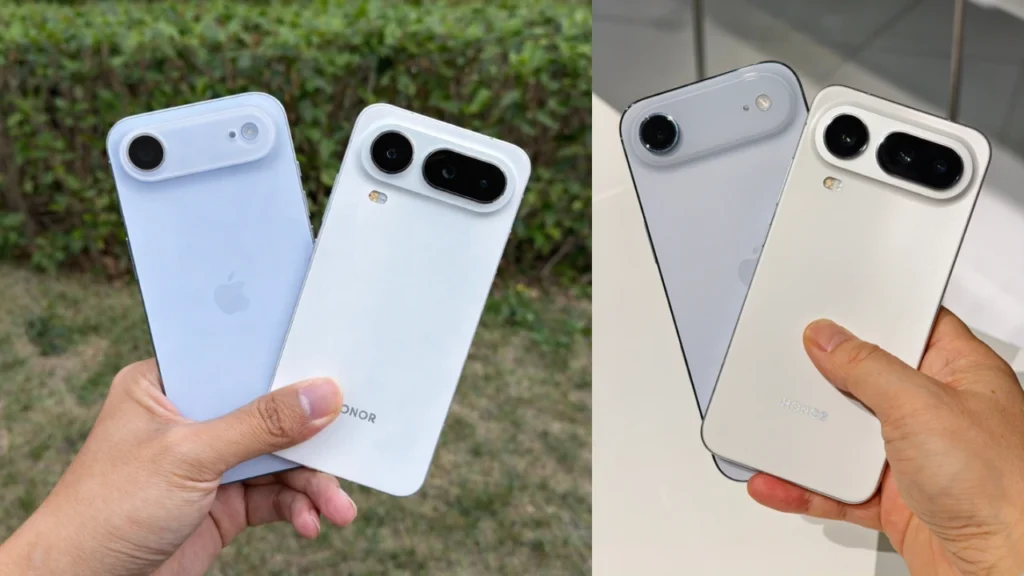
Comparing the Honor Magic 8 Pro Air and the iPhone Air isn’t just a spec-sheet contest between two of the thinnest phones on the market. These devices reflect two very different priorities. Honor is trying to deliver a full flagship experience in a slimmer body, while Apple treats thinness as the core product — and simplifies hardware to achieve a design that feels almost unreal in the hand.
That choice won’t please everyone, but it’s clearly deliberate. Here’s a focused comparison of what each phone gets right, where the compromises land, and who should buy which.
Design and build quality
The Honor Magic 8 Pro Air is 6.1 mm thick and weighs 155 grams, making it thinner and lighter than most high-end phones. It’s built around a durable aerospace-grade aluminum frame that Honor says is even more robust than the titanium frame of the iPhone Air. The rear design features a horizontally aligned triple-camera setup, which gives it a more complete flagship look than minimalist alternatives.
Honor also pushes premium finishing. The body uses a 7-layer light sensor coating similar to luxury cars, giving it a soft satin texture that’s comfortable in the hand. It comes in Purple, Orange, White, and Black, and includes IP68/IP69 dust and water resistance, adding the kind of protection you want on a daily-use flagship.
The iPhone Air creates the opposite impression. The first thing you notice is the extreme thinness — it feels unusually slim, almost unrealistic. The glossy titanium frame paired with glass looks refined but tends to attract fingerprints, so it’s elegant yet high-maintenance. Apple’s single rear camera sits flush, avoiding a protruding module and helping weight distribution feel balanced. Color options are more subdued: Sky Blue, Pale Yellow, Space Black, and Cloud White. Buttons like the Action Button and Camera Control remain, keeping familiar quick-access functionality for apps and photography.
Overall, Honor chases balance between durability and aesthetics, while the iPhone Air prioritizes design purity and in-hand comfort — even if that reduces versatility.
Display
The Honor Magic 8 Pro Air features a 6.31-inch LTPO OLED display with 1.5K resolution and a 120Hz refresh rate. Its standout spec is maximum brightness of up to 6,000 nits, designed for strong visibility in harsh lighting. Thin bezels help the screen feel immersive despite the relatively compact size. Honor also includes eye protection technologies and an in-display ultrasonic fingerprint sensor, signaling a focus on long-term usability.
The iPhone Air has a 6.5-inch Super Retina XDR OLED display. While its maximum brightness is lower than Honor’s, it still stands out for excellent color and contrast calibration. ProMotion allows the refresh rate to shift flexibly from 1 to 120Hz, balancing smoothness with power efficiency.
If you care about brightness and aggressive display hardware, Honor leads. If you value stable calibration and software-driven refinement, the iPhone Air delivers the Apple-style polish many buyers prefer.
Performance and software
The Honor Magic 8 Pro Air runs on the MediaTek Dimensity 9500 processor built on a 3nm process. It’s designed to maintain stable performance for extended workloads like video editing and demanding games. With 12GB or 16GB RAM options, multitasking is a major strength, keeping apps active longer and reducing frequent reloads.
It runs MagicOS 10 based on Android 16, heavily focused on AI and personalization. Users can customize the interface deeply, manage resources, and use AI tools for work — including task suggestions, performance optimization based on habits, and processing images or text directly on the device.
The iPhone Air uses the A19 Pro chip, Apple’s top-of-the-line processor from the iPhone 17 Pro generation. It continues to lead single-core performance tests and handles demanding tasks such as 4K video recording, video editing, and on-device AI processing. However, due to its thin body, the iPhone Air warms up faster under continuous heavy load, though temperatures remain within safe limits and don’t significantly affect short-term use.
iOS 26 remains a major advantage for system optimization. The liquid glass interface modernizes the visual experience, while Apple Intelligence adds practical AI features like real-time translation, image recognition, and automatic information processing. The iPhone Air’s biggest strength is long-term software update support and high stability, making it ideal for those who want smooth performance with minimal intervention.
In short: Honor excels in hardware flexibility, multitasking, and Android versatility, while Apple wins on long-term stability, optimization, and ecosystem sync.

Camera system
onor offers a full multi-lens setup: a 50MP main sensor, a 50MP ultra-wide lens with a 112° field of view, and a 64MP telephoto lens with 3.2x optical zoom and 100x digital zoom. This gives users a wide range of focal lengths and more flexibility across lighting conditions.
The 50MP selfie camera delivers noticeably higher resolution than its competitor, producing sharp selfies with natural skin tones. AI beauty enhancement, software stabilization, and light optimization help preserve detail in low light.
The iPhone Air uses a single 48MP rear camera — a major trade-off made to achieve its record-breaking slimness. However, Dolby Vision HDR video recording is a key highlight, supporting a strong video experience with wider color and dynamic range. The compromise is clear: without dedicated ultra-wide and telephoto lenses, the iPhone Air isn’t suited for users who want flexible focal length switching within the same scene.
Up front, the iPhone Air features an 18MP camera that maintains Apple’s reputation for consistent focusing and light capture. Center Stage automatically adjusts framing during video calls or video recording, useful for group calls and vlogs. Still, in good lighting, its resolution and detail reproduction fall short of Honor’s 50MP selfie camera when comparing still images.
Bottom line: Honor provides a complete photography toolkit across lenses, while the iPhone Air focuses on streamlined shooting and strong HDR video performance.
Battery and charging
The Honor Magic 8 Pro Air stands out by combining a slim build with a 5,500 mAh silicon-carbon battery, exceeding most slim and lightweight high-end phones and ranking among the largest batteries currently available.
In real use, that capacity can deliver nearly a full day even under high-intensity activity — web browsing, 120Hz video streaming, moderate gaming, and constant notifications. MagicOS optimization helps reduce unnecessary background drain.
Charging is another advantage: 80W fast charging can typically reach 50–70% in 30–40 minutes. The phone also supports 50W wireless charging and reverse wireless charging for accessories like earbuds or smartwatches.
The iPhone Air uses a battery of approximately 3,149 mAh, much smaller than Honor’s. Apple’s optimization helps, and it can last a full day for typical use like browsing and light photography. But high-intensity users — especially those who game or shoot video frequently — may need an afternoon recharge.
Charging support includes 20W wired fast charging and 20W Qi2 wireless charging. It’s stable and safe, but far behind Honor’s 80W capability, and Apple does not officially support reverse charging.
So, should you buy the Honor Magic 8 Pro Air or the iPhone Air?
Choosing between these phones depends on what you prioritize daily. Both chase thinness, but they get there in different ways — and the trade-offs are not subtle.
The Honor Magic 8 Pro Air is better for users who want a full-featured flagship experience: a large battery, faster charging, and a versatile multi-lens camera system. It’s built for heavy use, handling gaming, editing, shooting, and extended work without the same battery anxiety.
The iPhone Air is for buyers who value design, portability, and long-term stability. Its ultra-thin body and premium materials create a distinct in-hand experience, while iOS delivers smooth performance, fewer bugs, and long-term updates. And if you already use Apple devices like MacBooks, iPads, or Apple Watches, the iPhone Air offers a noticeably seamless workflow.
Ultimately, the Magic 8 Pro Air is the stronger choice for power users who want thin without sacrifice, while the iPhone Air is for those who prioritize the thinnest iPhone experience and accept Apple’s design-first decisions.

Tanu is a technology content writer at gemch.in who tracks smartphone launches, features, and pricing trends. She writes user-focused articles that explain what matters most in everyday smartphone use.