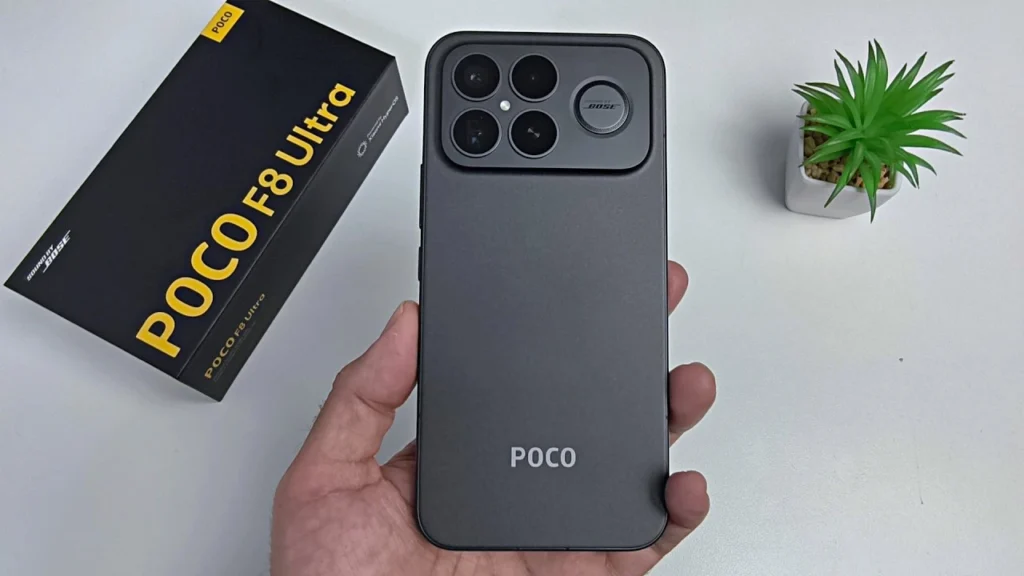
Poco’s F8 Ultra arrives in a market full of lookalikes and manages to carve out an unmistakable identity. From the faux-denim finish to the oversized display and battery, this phone isn’t trying to blend in — it wants to be chosen for practical reasons, not just aesthetics. That confidence is the device’s strongest selling point, but it also forces buyers to weigh a few clear trade-offs.
Poco F8 Ultra — key specifications
- Size: 163.3 x 77.8 x 7.9 mm / 8.3 mm
- Weight: 218 grams / 220 grams
- Screen: AMOLED, 6.9 inches, 1200 x 2608 pixels, 120Hz, HDR10+, 3500 nits
- Front camera: 32 MP
- Rear camera: 50 MP + 50 MP + 50 MP
- Processor: Snapdragon 8 Elite Gen 5 (3 nm)
- Battery: 6500 mAh
- Charging: 100W wired, 50W wireless
- Dust and water resistance: IP68

Exterior design that actually feels different
The Denim version immediately separates the F8 Ultra from glossy sameness. The faux-denim back looks and feels intentional: it improves grip, resists fingerprints and gives the phone a distinctly tactile character. The large rectangular camera module and a dedicated Bose speaker add to the device’s modern, slightly industrial look rather than borrowing polished flagship cues.
At 6.9 inches and roughly 220 grams, the phone is large but ergonomically manageable: gently rounded aluminum edges and the textured back keep it comfortable in one hand. This is a design that signals personality and purpose — but that size won’t please everyone; those who value pocketability or one-handed use will notice the compromise instantly.
A display built for impact
The 6.9-inch HyperRGB AMOLED panel is a showpiece. The full RGB pixel layout, 120Hz refresh rate, and a 2608 x 1200 resolution produce vivid colors and sharp detail. Poco says the screen covers almost the entire DCI-P3 gamut, and in daily use the brightness range — nearly 3,400 nits peak and under 1 nit minimum — means the phone performs at both sunny outdoor and late-night viewing extremes.
Poco Shield Glass adds durability, and the in-display ultrasonic fingerprint plus facial recognition make unlocking snappy and secure. If you watch lots of video or game frequently, the F8 Ultra’s screen will feel like a meaningful step up from typical mid-rangers. The trade-off: the size that elevates media consumption will demand more from your pockets and hands.

Camera system: capable, not best-in-class
The triple 50MP camera array is versatile on paper: main wide with f/1.67 and OIS, a 50MP ultra-wide, and a 50MP periscope telephoto with 5x optical zoom and OIS. In practice the main sensor delivers detailed, color-faithful photos with a healthy dynamic range. Ultra-wide shots trend a touch cooler and lose ground in low light, while telephoto zooms (5x and up to 10x) are surprisingly competent, preserving detail better than many competitors in this segment.
Selfies are handled by a 32MP front camera, and video tops out at 8K/30fps. Video color and stability are solid but don’t outshine still photography. Bottom line: the camera package covers most real-world needs and is impressively flexible — but it won’t dethrone flagship camera systems, and that’s an important buyer consideration.
Performance that leans on raw power
Under the hood the Snapdragon 8 Elite Gen 5, paired with up to 16/512GB memory, keeps the F8 Ultra responsive across multitasking, productivity and gaming. Benchmarks show strong graphical results and the cooling setup generally stops sustained loads from throttling performance. Under extreme stress the phone can get uncomfortably warm to hold, even when internal temperatures remain controlled — a concession to raw power that some users will accept, others will resent.
For anyone prioritizing smooth performance and large-memory configurations, this is a clear win. If long gaming marathons in handheld mode are your norm, think about that heat and ergonomics trade-off.

Battery life and charging that remove anxiety
A 6,500 mAh battery is the headline: real-world use delivers excellent endurance, with long browsing sessions and full-day heavy use handled comfortably. Media playback and gaming at loud volumes drain the battery faster (subwoofer power draw is a factor), but at moderate volumes the phone’s longevity is impressive.
Charging is speedy: 100W wired charging fills the battery in roughly 39 minutes and hits nearly 80% in about 30 minutes. The device also supports 50W wireless charging, though you’ll need a compatible charger to access that speed. For users who hate battery anxiety, the F8 Ultra’s combination of capacity and charge speed is a decisive advantage.
Who should buy the Poco F8 Ultra?
Buy this if you want a bold, practical phone: standout design, a large, class-leading display, long battery life, and top-tier raw performance for the price. The F8 Ultra is for users who prioritize everyday stability, media and gaming performance, and fast charging over camera supremacy or the longest possible software support.
This choice won’t please everyone. If camera pedigree or the most extensive update lifecycles are your top priorities, competitors with stronger software promises or flagship camera hardware will be more suitable.

Final verdict
Poco F8 Ultra is a confident, purpose-built phone that chooses to excel where it matters for many users: display, battery, and performance. It doesn’t pretend to be the best camera phone or the most compact device on the market, and that bluntness is part of its appeal. For buyers who want a distinctive, capable everyday flagship experience — and can live with the trade-offs — the F8 Ultra is an easy recommendation.

Tanu is a technology content writer at gemch.in who tracks smartphone launches, features, and pricing trends. She writes user-focused articles that explain what matters most in everyday smartphone use.