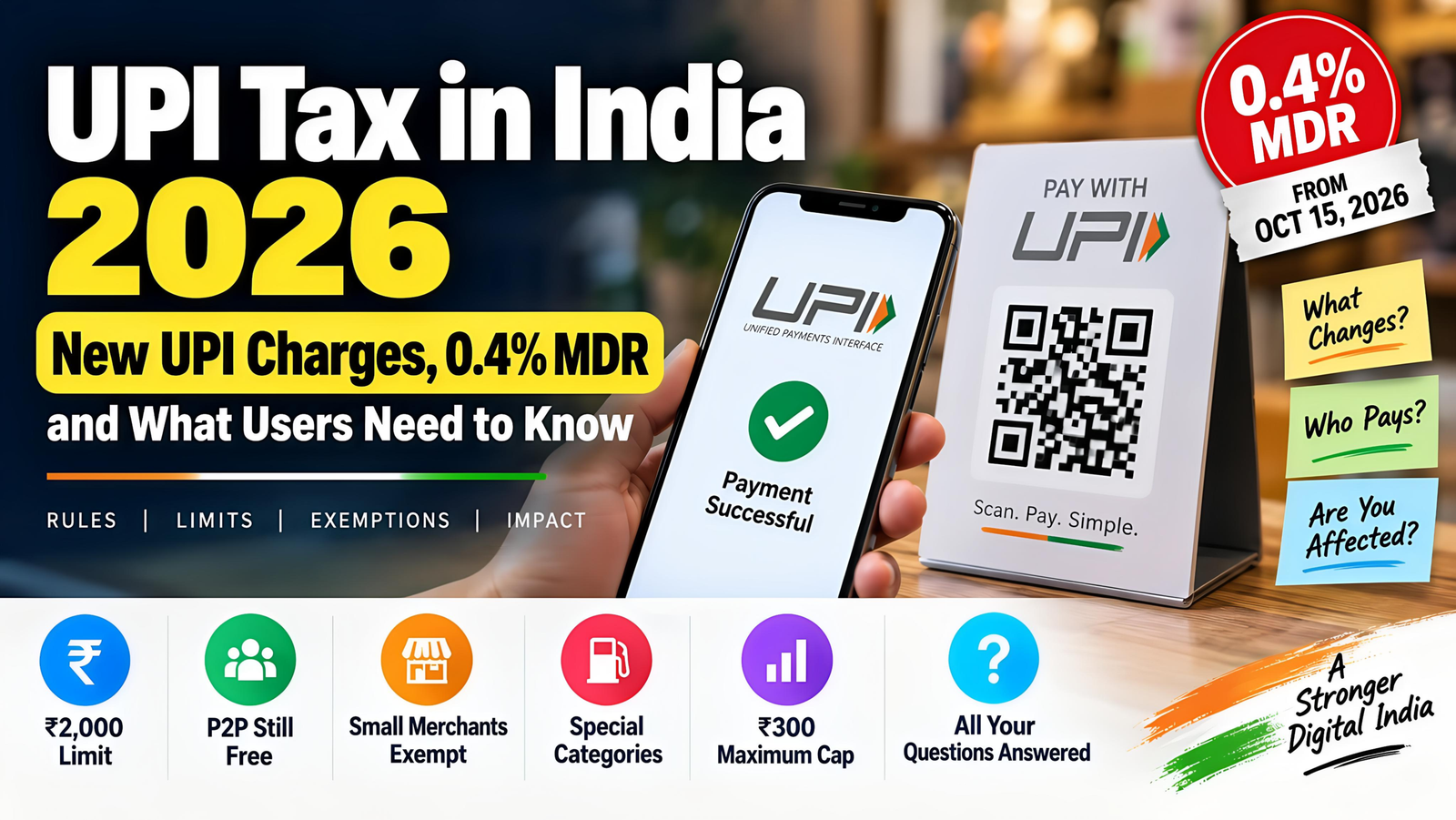
UPI has become one of the most widely used digital payment methods in India. Millions of people use it every day to pay at shops, transfer money to friends and family, pay bills and make online purchases. According to the National Payments Corporation of India (NPCI), UPI processed more than 24.5 billion transactions worth about ₹29.82 lakh crore in August 2026.
Now, a new charge structure for certain UPI transactions is set to come into effect from October 15, 2026. The announcement has led to widespread discussion about a so-called “UPI Tax.”
However, the new charge is not an income tax or a tax imposed directly on ordinary UPI users. It is a Merchant Discount Rate (MDR) applicable to certain person-to-merchant (P2M) transactions.
So, will you have to pay extra when using UPI? Which transactions will attract a charge? What happens to payments below ₹2,000? And will sending money to friends and family remain free?
Here’s everything you need to know.
What Is the New UPI Charge?
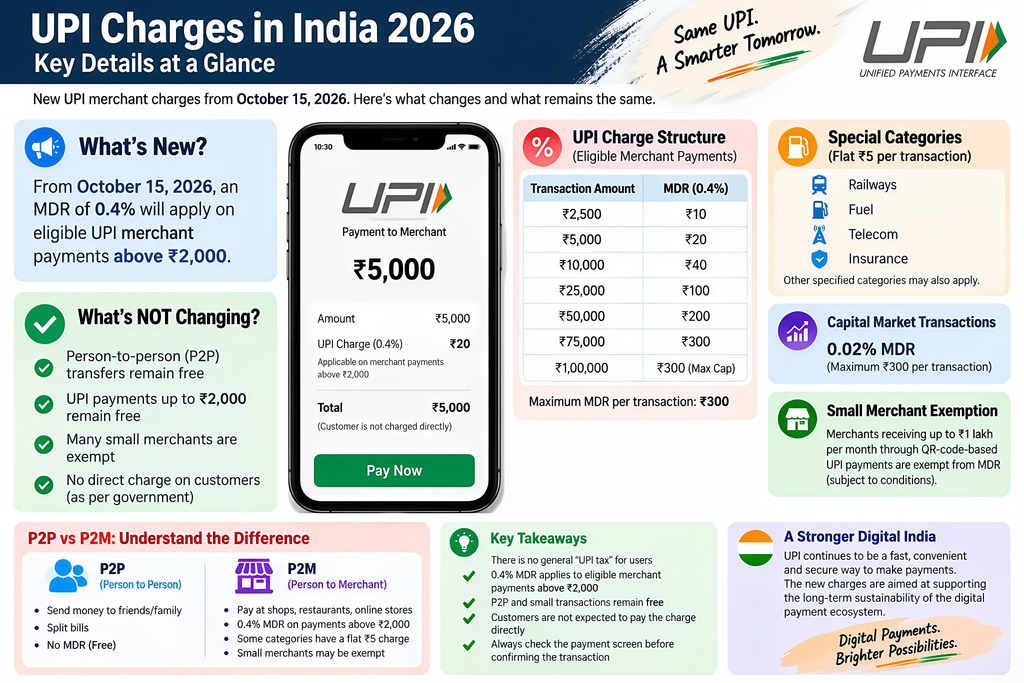
From October 15, 2026, an MDR of 0.4% will apply to eligible UPI person-to-merchant transactions above ₹2,000.
MDR stands for Merchant Discount Rate. It is a fee associated with processing a merchant payment through the digital payment ecosystem.
The key point is that this is not a tax on the consumer’s income or a general tax on UPI payments.
The new framework is aimed at certain merchant transactions, while person-to-person payments and specified exempt transactions remain outside the standard 0.4% MDR structure.
Is UPI Tax Being Introduced in India?
No, it is more accurate to call it a UPI MDR or merchant charge rather than a UPI tax.
The term “UPI tax” has become popular in discussions because the new MDR will introduce a cost for certain UPI transactions.
However, MDR and tax are different.
A tax is a compulsory payment imposed by the government under tax law.
An MDR is a payment-processing charge within the payments ecosystem.
The government has also stated that the charge is intended to apply to merchants rather than directly to consumers.
When Will the New UPI Charges Start?
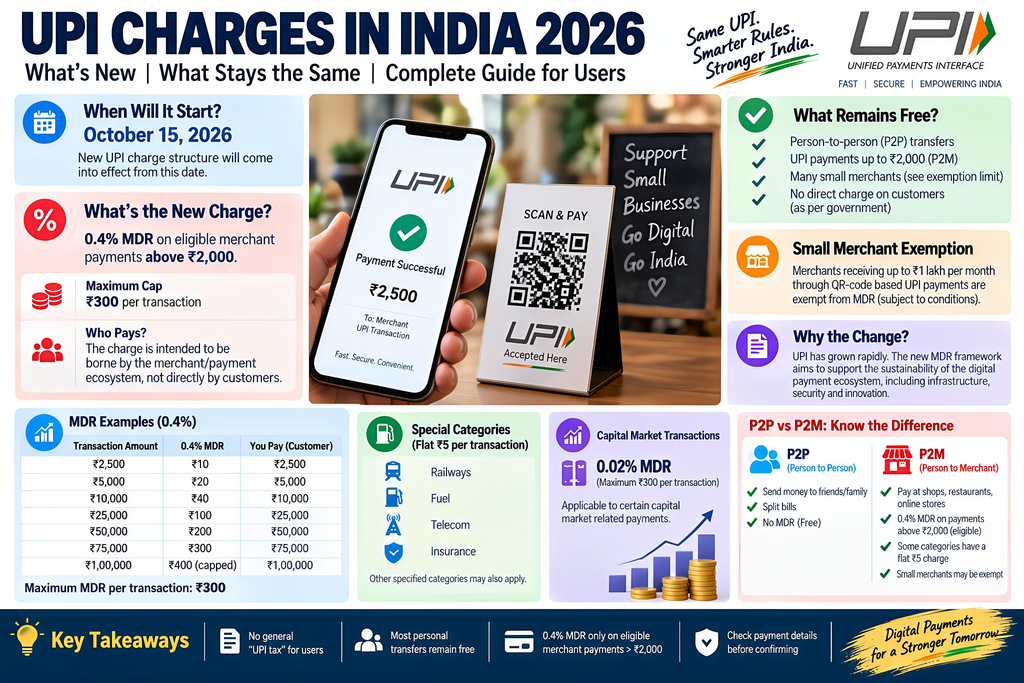
The new MDR structure will come into effect from: October 15, 2026
The standard MDR for eligible person-to-merchant UPI payments above ₹2,000 will be 0.4%, subject to the applicable exemptions and caps.
How Much Is the New UPI MDR?
For eligible transactions above ₹2,000, the standard MDR is:
0.4% of the transaction value
There is also a maximum cap of ₹300 per transaction for the standard MDR structure.
Examples
| UPI Merchant Payment | 0.4% MDR | Maximum applicable MDR |
|---|---|---|
| ₹2,500 | ₹10 | ₹10 |
| ₹5,000 | ₹20 | ₹20 |
| ₹10,000 | ₹40 | ₹40 |
| ₹25,000 | ₹100 | ₹100 |
| ₹50,000 | ₹200 | ₹200 |
| ₹75,000 | ₹300 | ₹300 |
| ₹1,00,000 | ₹400 | ₹300* |
*The standard MDR is capped at ₹300 per transaction.
The actual amount charged within the payment ecosystem can also depend on the applicable category and exemptions.
Will Customers Have to Pay the 0.4% UPI Charge?
For the new MDR structure, the charge is intended to be levied on the merchant/payment ecosystem rather than directly on the customer.
In other words, if you pay a shopkeeper ₹5,000 through an eligible UPI merchant transaction, the new MDR does not mean that ₹5,020 will automatically be debited from your bank account.
The government has stated that banks and UPI providers should not pass the MDR directly to consumers.
However, merchants and payment providers operate under specific commercial arrangements, so consumers should still check the final amount shown on the payment screen before completing a transaction.
Will UPI Payments Below ₹2,000 Be Charged?
Under the new standard MDR structure, UPI person-to-merchant payments of ₹2,000 or less will remain exempt from the 0.4% MDR.
This means a ₹500 or ₹2,000 payment at an eligible merchant will not attract the standard 0.4% MDR.
Will Sending Money to Friends and Family Cost Money?
No, the new 0.4% MDR is not intended for ordinary person-to-person (P2P) transfers.
For example:
- Sending ₹1,000 to a friend → No standard 0.4% MDR
- Sending ₹10,000 to a family member → No standard 0.4% MDR
- Receiving money from another person → No standard 0.4% MDR
The new structure primarily concerns person-to-merchant (P2M) transactions.
What Is P2P and P2M UPI Payment?
Understanding the difference is important.
P2P — Person to Person
This is when you send money directly to another individual.
Examples:
- Sending money to a friend
- Sending money to a family member
- Splitting a restaurant bill with friends
P2M — Person to Merchant
This is when you pay a business or merchant.
Examples:
- Paying a shop through a QR code
- Paying a restaurant
- Paying an online merchant
- Paying a business for goods or services
The new 0.4% MDR primarily applies to eligible P2M transactions above ₹2,000.
Are Small Merchants Exempt From the New UPI MDR?
Yes. The new framework provides an exemption for eligible small merchants meeting the specified threshold.
Merchants receiving up to ₹1 lakh per month through QR-code-based UPI payments are reported to be exempt from the MDR, subject to the applicable conditions.
This means many small shops and local businesses may not be affected by the standard MDR.
The purpose of this exemption is to prevent additional payment-processing costs from disproportionately affecting smaller merchants.
Are There Any Special UPI Charges?
Yes. Certain categories have a different fee structure rather than the standard 0.4% MDR.
For example, specific sectors such as railways, fuel and telecom have been reported to have a flat ₹5 per transaction charge under the new structure. Insurance and certain other specified categories are also included in the special-category framework.
This means you should not assume that every UPI payment above ₹2,000 will simply be charged 0.4%.
The applicable category matters.
What About Very Large UPI Transactions?
For standard eligible merchant transactions, the MDR is capped at ₹300 per transaction.
For example, 0.4% of ₹1 lakh would be ₹400. But because of the ₹300 cap, the standard MDR would not exceed ₹300 for that transaction.
Certain categories can have different rates or caps, so the applicable rules should always be checked for the specific transaction type.
What About Capital Market Transactions?
The new framework also provides a separate MDR structure for certain capital-market transactions.
Reports on the NPCI framework indicate a 0.02% MDR for capital-market payments, with a maximum cap of ₹300.
This is separate from the standard 0.4% MDR applicable to eligible merchant transactions.
Why Is UPI MDR Being Introduced?
UPI has operated for years with a zero-MDR model for many transactions.
As UPI usage has grown dramatically, maintaining the payment infrastructure involves costs related to:
- Technology infrastructure
- Cybersecurity
- Fraud prevention
- Payment processing
- Banks and payment service providers
- Customer support
- Expansion and maintenance of the digital payment ecosystem
The new MDR structure is intended to create a revenue mechanism for parts of the UPI ecosystem while retaining free access for several important categories of transactions.
Will Google Pay, PhonePe and Other UPI Apps Charge Users?
The introduction of MDR does not automatically mean that users will have to pay a new fee every time they use Google Pay, PhonePe, Paytm or another UPI application.
The standard MDR is associated with eligible merchant transactions and is intended to be borne within the merchant/payment ecosystem rather than directly charged to consumers.
Therefore, the important distinction is:
UPI app ≠ automatic consumer fee
The exact treatment of a transaction depends on its category, merchant status and applicable payment rules.
Is UPI Still Free for Personal Transfers?
Yes.
The new MDR framework does not introduce the standard 0.4% charge for ordinary P2P money transfers.
So, if you use UPI to send money to a friend or family member, the new merchant MDR does not apply simply because the amount is above ₹2,000.
Does the New UPI MDR Mean UPI Is No Longer Free?
That depends on what type of transaction you are talking about.
UPI is not becoming universally chargeable.
Instead, a specific MDR structure is being introduced for certain merchant transactions.
Still outside the standard 0.4% MDR
- Person-to-person transfers
- P2M payments of ₹2,000 or less
- Eligible small merchants within the specified exemption
- Other transactions specifically exempted under the applicable rules
Subject to new MDR framework
- Eligible P2M transactions above ₹2,000
- Certain specified categories with separate charges
- Certain capital-market transactions with a separate MDR
UPI MDR vs UPI Tax: What’s the Difference?
| UPI MDR | UPI Tax |
|---|---|
| Merchant Discount Rate | Tax imposed under tax law |
| Payment-processing charge | Government tax |
| Applies to specified eligible transactions | Would apply according to tax rules |
| Primarily concerns merchants/payment ecosystem | Could directly affect taxpayers depending on the tax |
| 0.4% standard MDR for specified transactions | There is no general “UPI tax” of 0.4% on users |
Therefore, calling the new MDR a “UPI Tax” can be misleading.
A more accurate description is new UPI merchant charges/MDR.
What Should UPI Users Do?
For ordinary users, there is no need to stop using UPI simply because of the new MDR framework.
Instead:
- Check the amount before confirming a payment.
- Make sure you are paying the correct merchant.
- Review any additional charge shown on the payment screen.
- Keep transaction receipts for important payments.
- For large business payments, understand whether the transaction falls under a special category.
- Never share your UPI PIN with anyone.
Most importantly, remember that the new 0.4% MDR is not a blanket tax on all UPI users or all UPI transactions.
Frequently Asked Questions About UPI Charges 2026
Is there a new UPI tax in India?
There is no general 0.4% tax on UPI users. From October 15, 2026, a 0.4% MDR is scheduled for certain eligible merchant transactions above ₹2,000.
Will I be charged 0.4% when sending money to a friend?
No. The standard MDR applies to eligible merchant transactions, not ordinary person-to-person transfers.
Will UPI payments below ₹2,000 remain free?
Under the new standard MDR structure, eligible P2M transactions of ₹2,000 or less remain exempt from the 0.4% MDR.
What is the maximum UPI MDR?
For the standard eligible merchant transaction structure, the MDR is capped at ₹300 per transaction. Certain special categories have separate rates.
When will the new UPI charges start?
The new MDR framework is scheduled to take effect on October 15, 2026.
Will Google Pay and PhonePe charge me for UPI payments?
The new MDR does not mean that every Google Pay or PhonePe user will automatically be charged. The standard MDR applies to specified merchant transactions and is intended to be handled within the merchant/payment ecosystem.
Is UPI P2P still free?
Yes. Ordinary person-to-person UPI transfers remain outside the standard 0.4% merchant MDR framework.
Is the 0.4% charge paid by the customer?
The announced framework places the MDR on the merchant/payment ecosystem rather than directly on the consumer. The government has stated that the charge should not be passed directly to consumers.
Final Takeaway
The new UPI charging framework does not mean that India has introduced a blanket “UPI tax.”
From October 15, 2026, eligible UPI merchant transactions above ₹2,000 will be subject to a 0.4% Merchant Discount Rate, with a standard maximum of ₹300 per transaction. Payments of ₹2,000 or less under the standard P2M structure, ordinary person-to-person transfers and eligible small merchants remain outside this standard MDR. Certain sectors and transaction categories have separate fee structures.
For consumers, the key message is simple: you do not suddenly have to pay a 0.4% “UPI tax” every time you make a UPI payment. The impact depends on the type of transaction, the merchant and the applicable MDR rules.
As the new framework takes effect, users and merchants should check the applicable charges shown by their bank or payment provider and rely on official NPCI and government updates for any subsequent changes.